
THE CRISIS OF MEANING
In a modern world drowning in technological progress and the illusions of AI, we have still not found an answer to the most important question: why are we here? Material comfort only deepens our existential emptiness, while mass pop-astrology — both its psychological and purely technical forms — has finally distorted the ancient art, turning it into a sweet fast-food of self-deception and false hopes. What, then, is the true meaning of astrology? It is this question that we seek to answer in the present article.
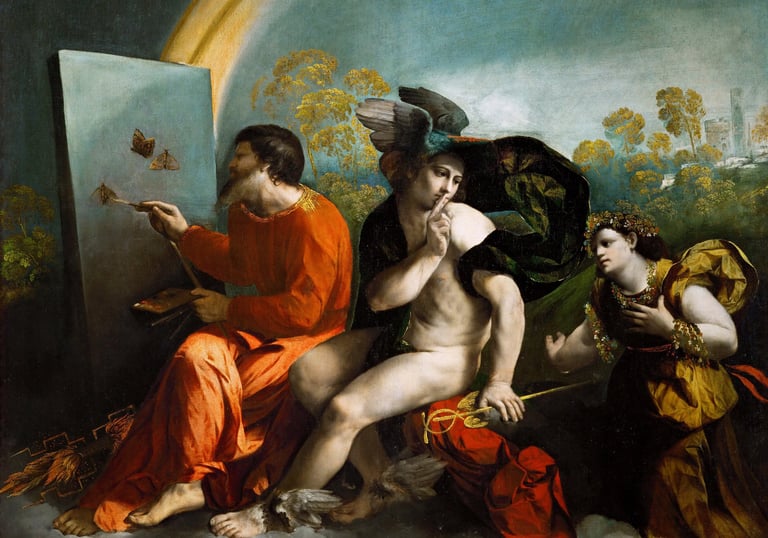
The Crisis of Meaning
One of the most profound and serious advances made by science in recent decades has been the deep recognition of the crisis of meaning in the modern world. No matter how beneficial material-scientific progress and its consequent technological achievements may be, in the end they do not address what matters most. They cannot fill the existential void that has taken root in the hearts of contemporary people, for they are unable to transcend their own limits and lead humanity beyond matter—into the realm of higher consciousness, the only sphere truly capable of grasping the meaning of existence and attaining genuine happiness. The fact that, over the past centuries, science has failed to turn humanity away from the search for a non-material meaning only proves the fundamental flaw in its approach to this question.
Reason, in its purely material, vital, and physical manifestations, when employed in the quest for answers, is no more than the visible tip of the iceberg of meanings. Studies of the brain and its connections to purely bodily consciousness—as pursued by Ray Kurzweil and other transhumanists—remain pale attempts to cross the invisible boundary between matter and physical intellect. The few contemporary scholars and philosophers who venture further—John Vervaeke, Mark Vernon, Bernardo Kastrup—seek to peer deeper in their effort to escape the impasse. Their pursuit of a more fundamental meaning rests upon a synthesis of ancient philosophy, modern psychology, and cognitive science, allowing them, to some extent, to trace the relationship between consciousness and matter—rather than the reverse. This is a significant step forward in the right direction. Yet this movement proceeds side by side with purely scientific progress, which increasingly engulfs every vital sphere of our lives.
Technological progress brings comfort, but it also generates countless distortions of reality. It simultaneously improves the quality of life and diminishes our understanding of ourselves. Today, it seems, we can generate images and voices, create texts, videos, photographs, and countless other things with the help of AI. Yet in essence all of this is nothing more than illusion. An AI-generated video, a voice overlaid on a composition and subtly altered, or a text written in this or that style—none is more than a beautiful mirage that creates a false impression of oneself, first and foremost as a director, writer, artist, musician, or whatever role one assumes in life without truly embodying it. A handsome avatar behind which lies another reality—often diametrically opposed to the image created. A mask that conceals, and frequently distorts, the truth. In the end, everything comes down to the simplest questions: Does this make us better? Does it set before us new horizons of achievement and new questions? More often than not, the answer is no. Ultimately, all of it is merely an attempt to fill the yawning abyss of dissatisfaction with oneself and with life—an attempt to present oneself in a different, desired, yet often unattainable light. Of course, I speak here of the mass use of AI, not its purely technical application in fields such as the film industry.
Yet the crisis of meaning is not merely global, engulfing the greater part of humanity—often led by what Charlie Chaplin, in the figure of the Great Dictator in 1940, called “these unnatural men—machine men with machine minds and machine hearts.” Above all, it is all-pervasive. It fills not only our hearts but every sphere of our life and activity. This very fact reveals its existential nature. For the mystery of life is not hidden in any single domain. It does not belong exclusively to science, philosophy, or religion. No. It must be unveiled everywhere—in every sphere and in every heart. The discovery of meaning in one thing draws us closer to its discovery in all the rest. And it matters little which sphere we choose—some branch of science, philosophy, psychology, theology, or even something as seemingly distant as business or sport. For it is often in such outwardly opposite realms that the substitution of meaning and the perversion of purpose become most glaringly apparent.
Astrology, too, stands not apart. In its primordial form it is an inseparable part of the world’s heritage. To uncover its authentic meaning is no less important than to uncover the meaning of religion or philosophy. After all, it was created not only to allow us a glimpse into the future, but also to help us better understand ourselves and the world, and our place in the great drama played out on the fields of eternity. Distorted to the point of comedy and unrecognizability by most of its modern adherents, it nevertheless remains accessible in its pristine purity to those who are accustomed to look beyond the outer veil—into the realm of celestial harmony, which appears as chaos to our senses and as Cosmos to our reason.
What, then, is its true meaning? It is to this question that we shall attempt to find an answer in the present article—an answer we hope will, in some measure, help avert the crisis that has overtaken astrology in the last decade.

When we encounter modern astrology, we first and foremost encounter distortion. This distortion bears many names, the most popular being astro-psychology in the spirit of Liz Greene, Stephen Arroyo, Dane Rudhyar, and Carl Gustav Jung, and “classical” astrology in the modern sense—in the spirit of Alan Leo, Sepharial, and Charles Carter. The latter bears the same relation to true classicism as the former does to psychology. Neither has anything to do with authentic astrology. This is a simple substitution of meaning, not “another” astrology. Astrology cannot be “another,” “different,” or anything else. Just as mathematics cannot be anything other than mathematics. If we invent for ourselves some personal understanding of numbers detached from primordial reality, we may distort mathematics, but we shall not alter its essential purpose. The same holds for astrology.
For the most part, modern astrology resembles dopamine fast food, operating under the motto “quick, tasty, and harmful.” Or, more plainly — vague, useless, false. It is enormously popular and divides into two main streams: the psychological and the technical. One focuses on psychology, crafting an image detached from reality; the other on forecasting techniques, offering possible scenarios of events. Both provide false hope rather than truth as it is. They are like chocolate that lifts the mood but does not relieve suffering. Moreover, the absence of precision, sacrificed to vague formulations and “possibilities,” absolves those who serve the masses this psychological vinaigrette in blogs, columns, magazines, or website articles of all responsibility. We shall not err if we call it all yellow astrological press—something reminiscent of conspiracy theories without evidence or common sense. One must be exceedingly naïve to believe that one-twelfth of the Earth’s population will face something unexpected tomorrow, or that Saturn’s ingress into Aries will open a new karmic cycle. Of course, it is interesting and one wants to believe. After all, we can always stretch something by the ears from these karmic possibilities and unexpected circumstances. But all of it is no more than a rainbow illusion behind which lies nothing concrete—only soap bubbles of hope that burst the moment real life touches them. And yet, even behind this face distorted beyond recognition shines the light of true astrology: precise, concrete, verifiable in time, and uncompromising toward lies and illusions. For in the world there is no absolute falsehood—only a distorted mask of truth, a twisting of reality.
We might call modern astrology pop-astrology, for it is as popular among the masses as Korean K-pop with its fanaticism and eclectic genres. Popularity arises not so much from likes or subscriber counts as from catching the spirit of the age—when we sense the movement of collective consciousness in one direction or another and respond to it here and now. People interested in karma? We give them karmic aspects. Psychology? We examine temperament and character through the planets, subconscious complexes, and childhood traumas. All of this creates an echo in space and a response in the masses. But all of it is doomed to wither as soon as the fashion and demand for psychology or karma subside. And this is one of the fundamental differences between modern astrology and the authentic. The former is rooted in materialism and anthropocentrism; the latter in cosmological symbolism. The former depends on demand and the times; the latter depends on nothing, yet is capable of answering everything. Not an answer to ignorance and the desire for light, undemanding content. Not some astrology made easy. But a gaze upon meaning and development in time. Not Virgos and Tauruses, but timings, events, and their meaning.
Someone will say that modern astrology is simply another paradigm, an evolution of the astrology of the past. But this is only half-truth, masking the loss of cosmological foundation beneath a variety of approaches. In essence, it is ordinary distortion. Authentic astrology has always been an instrument for reading the objective order within time: Cosmos and symbol, fate and event. Not a tool of self-reflection. Not psychology, self-knowledge, or personal growth. But the art of seeing the reflection of the higher in the lower, the heavenly in the earthly, the eternal in the temporal.
The idea of reflections goes back to Plato, in his allegory of the cave in the Republic, where the material world is presented as shadows, or reflections, on the wall of the cave, while true reality ascends to the world of Ideas. He says the same in the Timaeus, where the Cosmos appears as a living likeness of the eternal image fashioned by the Demiurge:
«…this cosmos is a living likeness of the Living Creature, an image of the eternal.»
He echoes the same idea in the Philebus and the Sophist. No philosopher embraced the idea of reflections more fully than Plotinus, who illustrated it with the example of the haruspices in the Enneads, in relation to divination:
«Haruspices and those who observe the flight of birds do not believe that birds cause events or that the entrails of animals produce what is foretold. No, they see in them signs, reflections, and images of what has already been determined in the higher order. All is bound together in the single harmony of the Cosmos, and these visible signs are like letters on a page reflecting the thought of the author. The bird does not cause the battle, but its flight is a reflection of what has already been decided in the higher world. Just as a face is reflected in a mirror, so in the sensible world is reflected what exists in the intelligible.»
If modern astrologers would delve a little deeper into this theme and apply what has been said to astrology, the idea of influences would fall away as unnecessary and distorting, and everything in astrology would fall into place. The conflict with science would also be practically resolved—except for its most intransigent representatives, who insist on seeing in everything the same repetitive patterns proper to matter, rather than the manifold diversity of the world of Ideas in its reflections.
Infinite variety is produced by the seven fundamental forces that underlie the Cosmos in their combinations. Their reflections are the planets in astrology. Not their physical bodies, manifestations, concentrations, or anything else—only reflections. Plotinus speaks of this further in the Enneads:
«All that is here is reflections and images of what is there. Matter is like a mirror that reflects forms from the Intellect, yet possesses none of them in itself. Just as a reflection in water shows a face but is not the face, so the sensible world shows the intelligible, yet in itself is only a shadow.»
Iamblichus held similar views, as we see in his treatise On the Egyptian Mysteries:
«Theurgic symbols and signs are not merely conventional signs, but real reflections and participants in divine powers. They operate not through mechanical causality, but through sympathetic connection and the reflection of the higher in the lower.»
Plato, Plotinus, Iamblichus, Proclus, Philo Judaeus, and many other philosophers of the past—including the composite figure of Hermes Trismegistus and the Corpus Hermeticum, especially the Poimandres—speak of the world as a reflection of the eternal, like the sun reflected in water. Yet modernity seeks to tell us otherwise. The greatest philosophers of the past, equals of whom have scarcely been born in the last several centuries, were mistaken. We, the children of the New Age—with our personal growth, coaching, karma, and psychology—know the truth better than anyone before us. Evidently we are to accept this claim simply because today almost every monkey can tap on keys and speak into a receiver, earphones, or camera. The only thing that distinguishes us from antiquity is technological progress. But is it a symbol of progress of the human mind and soul? Has it made the world better? Has it changed humanity? Has it led us all to an understanding of universal brotherhood and true, not distorted, freedom? Has there been more goodness and love in the world? More sincerity and striving for truth? The answers to these questions will put many things in their proper places.
The distortion of foundations has supplanted reality, twisting it beyond recognition. It has created a crooked mirror in which everything appears not as it truly is. Celestial reflections have been replaced by projections of the psyche, precise predictions by karmic “workings-through,” events by mere possibilities. It is like an artificially created doppelgänger—a double of a person, outwardly similar, yet nothing more than a dark mask of the personality. A harbinger of death. The Dark Cooper from Twin Peaks. This is modern astrology. A psychological projection with an astrological cover. For pleasant lies are always sweeter than bitter truth. There is only one problem: with the years one realizes that this is not a pleasant pill but a poison that slowly kills.
Understanding that someone will not stop cheating and will continue to do so is far more important than empty words that this is merely “another karmic lesson” rather than the destruction of oneself and one’s life. In the first case we can make a choice—to stay or to leave—knowing that the betrayals will not cease. In the second we have no choice, even if with all our heart we do not wish to remain beside such a person. As a rule, the second shatters life and heart, leaving only faintly glowing embers of hope that perhaps this is indeed another karmic lesson and not the destruction of oneself and one’s life—in which the astrologer participates. Do you see the difference? The first shows things as they truly are, leaving a person freedom of choice—with all its consequences. The second removes responsibility from the person, shifting it onto vague words about karma and lessons, as though our entire life were not one continuous lesson in which the will is taken away simply because someone advised it so.
And here we come directly to the theme before us—what is the meaning of authentic astrology? If it differs so markedly from its modern distortion, being linked to the Source, then it must contain not only a different purpose but a different meaning. It must bring liberation. At least from falsehood. But is the truth of astrology contained solely in precise predictions? Or in an understanding of the particular features of a concrete person: his psychology, temperament, predispositions to illnesses and life events? Perhaps only in certain events of world scale? Or in something else?
We can speak and write only about what has become part of ourselves. About what has been experienced, assimilated, realized, understood. Only this can endow words with knowledge, power, feeling, or whatever else is transmitted through them. A reflection of mind and soul, if you will. Where does the meaning of words reside? In the words themselves? Or in what stands behind them and what they express?
Understanding of astrology is not constant. More precisely, it is subject to change. It grows and deepens with the years, or stagnates, or remains as it was at the beginning. And this depends not on the number of books read, predictions made, or years spent in astrology. No. It depends entirely on the growth of the astrologer’s own consciousness, on his contact with the Source.
Some are satisfied with precise predictions, some with vague phrases about human psychology, some with pure theory without practice, and some with dry practice without the living moisture of understanding. Here there are no general criteria by which we might construct a strict system—and systems are almost always nothing more than limitations of the mind—and draw some diagram entitled “understanding of astrology.” Each can speak only from personal experience, although of course there are certain common features we can trace and discern everywhere.
We are still not certain that we have grasped the final meaning, but without doubt we have opened a door behind which lies that very light which once gave birth to astrology itself. When we arrived at our present understanding of the meaning of astrology, we passed through several stages, each of which was a kind of Alpha and Omega of our practice over the course of several years. Naturally, as for the majority of those interested in astrology, it began with modern astrology—with its zodiacal forecasts and character descriptions—which then grew into purely technical predictive techniques involving the wide use of the trans-Saturnian planets: Uranus, Neptune, and Pluto. The first stage was undoubtedly purely psychological in character, most often having nothing in common with reality. The second was purely technical, with possible variations of event development based on ready-made patterns in the form of planetary and house characteristics. Most astrologers pass through this every day: Saturn transiting the third house and ruling the Ascendant means that in the coming year or two the native will face certain difficulties in short journeys or in relations with brothers and sisters. All in that typically vague and distorted spirit. But then Tradition entered our life in the person of John Frawley and changed us from within, radically, not merely outwardly. For many try to take only the external form of Tradition—usually its predictive techniques, which are utterly useless without context and thought—while remaining adherents of modern astrology, thereby distorting the former and substituting another meaning for it. It is like taking some antique piece of furniture merely to add zest to a modern-style room. Alas, we see this constantly, sometimes even among our own students. This rather strange attempt almost always ends in failure for them in mastering even horary astrology, which becomes for them merely a technical tool rather than an art that demands, first and foremost, self-surrender.
The key difference between traditional and modern astrology lies not only in the cosmological foundation upon which it rests and which serves as the source of predictions based on celestial reflections in the earthly or in the astrological chart, but also in the fact that it is able to show things as they truly are, and not as we would like to see them. And this is very difficult, especially at first, because instead of ready-made formulas we are asked to think about context, to keep fantasy on a short leash, and to draw clear and concise conclusions without the water of abstract words. And since modern astrology does not teach thinking but only memorization, mistakes in tradition are inevitable—at first. For one always tries to cling to past experience and import it into the new—which is not so much new as eternal. And this is the key error of astrological practice for those who move from modern to traditional astrology. One must leave past experience in the past. It is useful only insofar as it helps us understand the errors of modern astrology once we gain experience in the traditional.
It would be foolish to say that modern astrology is absolute falsehood and tradition absolute truth. No. The former also contains truth, but in distorted form. For example, when we determine temperament in modern astrology, we do so, on the one hand, on the basis of the positions of planets in signs—which should already suggest that in the course of a single day, on average, not only sanguines or melancholics can be born, with planets predominating in air or earth signs respectively; on the other hand, we do it merely to say many words about character and remain silent about the mode of action, predispositions to certain illnesses, and so forth. In tradition, temperament is the foundation of foundations of a person—the very bricks upon which his life and his body are built. And the ability to understand precisely the meaning of temperament, as well as its definition—which, incidentally, differs radically from the method of modern astrology, which does not take into account the cycles of the Moon and Sun, the predominance of certain humoral qualities such as cold or dryness, and much else—is key to the correct consideration of the entire natal chart. Thus, for instance, modern astrology would say of Mars in exaltation that this person is prone to aggression, achieves everything by force, or will be connected with law-enforcement structures, sport, and so on. Whereas tradition would ask: what temperament underlies this particular natal chart? Ah, it is melancholy, which means this person will not be prone to the nonsense mentioned above. We see this in the chart of Ray Bradbury, whose fame was connected not so much with what Mars itself signifies in a profession as with the fact that he wrote his The Martian Chronicles and Fahrenheit 451, which brought him worldwide renown and raised him to the pinnacle of fame—Mars in exaltation on the Midheaven. He could not have become a firefighter or an astronaut, but he could write about them. First and foremost thanks to his temperament, which shows us, among other things, the preferred mode of action. Leaving aside bodily constitution, predisposition to illness, and other important nuances whose correct understanding is possible only in tradition. As you can see, there is room for psychology in the latter, but in a highly practical key—not merely to speak about temperaments.
The first thing that strikes one in traditional astrology is its precise, concrete predictions. No “perhaps,” “maybe,” or “it all depends on your intention.” Everything is thoroughly pragmatic. Either you are accurate or you are wrong. Either you see the timing or you do not. And of course the precise predictions, which multiply with study and practice, begin to seem the very meaning of astrology. For once we read about the predictions of astrologers of the past and were quite vexed that modern astrology had not only failed to teach this but had not even answered the question “how?” Unlike the traditional, which not only gave answers but taught them in practice. For more than seven years this was the central meaning of our practice. Precise, time-verified judgments on horary charts seemed miracles and magic made real. Yet everything had a thoroughly justified character from the standpoint of astrology. Understanding of fundamentals and context—two keys that open the door to precise predictions. But then we began to ponder how and why this is possible, and what exactly lies behind the nature of astrological predictions. It was then that we began to approach a different meaning.
If we say that to know the nature of astrology and prediction it is enough to have books and textbooks on astrology together with personal experience, that would be a lie. Textbooks can teach us the basics, while practice can give knowledge. But neither the one nor the other will help us pierce the veil of the Mystery. In astrology there is something that does not fit within the frames of astrological texts yet is their inspiration and source. Whether we call it Mystery or Source, we shall not be wrong. The Mystery is at the beginning, the Source at the end.
The further we advanced in understanding astrology, the greater grew our interest not only in philosophy but also in cosmology—the structure of the Cosmos as seen by the ancient world, not by modern science. Least of all were we interested in the physical composition of the planets or the laws by which they move. Or rather, that was secondary compared with the symbolism that filled the life of our predecessors. To understand meaning we had to understand not only the symbol but the idea it contains.
We shall not be wrong if we assume that the majority of astrologers—and we ourselves were once among them—believe that planets influence our lives. This is one of the greatest illusions in astrology, which often creates an insurmountable gulf and conflict between science and astrology. When we speak of purely physical influences—such as the magnetism of the Moon, solar storms and cycles, chemical influences of planets, and so forth—all of this does indeed exist, but… none of it has anything to do with astrology. The planets—more precisely, only the seven of them—are nothing more than reflections of those cosmic forces by which the Cosmos was created and is permeated. We have already written about this in detail in our article “Nature's Book of Secrecy,” so we shall not dwell on it here. Let us say only that shifting the focus of consciousness toward symbolism puts everything in astrology in its rightful place. But understanding the symbolism of the planets is impossible without understanding the symbolism of the cosmic world-order. One thing is to turn to cosmography—modern astronomy; quite another to cosmology. These are two sides of the scale, like Spirit and Matter, soul and body, which are not opposites but mutual complements, like Sun and Moon, day and night. One is impossible without the other. It is like removing meaning from mathematics or purpose from scientific research. We need astronomy for knowledge and understanding of the movements of planets and stars, their cycles, and everything of a purely physical nature; but we need cosmology for understanding the meaning of that movement. Meaning we see in the astrological chart. It is symbolism that helps us understand why the position of planets in signs and houses, and their movement along the Zodiac, does not carry a universal meaning but an individual one, applicable to each separate person, nation, or state, or even to a simple question. This frees us from the erroneous astrological patterns about the meaning of the Moon in Taurus, or Mars in the fifth house, or Saturn’s ingress into Aries. Yes, we have certain general guidelines for events on a global scale—such as the Great Conjunctions that occur every twenty years, or the ingresses of the Guardians of Heaven—the four Royal Stars—into the signs of the Zodiac, which happen roughly every 2,160 years. But they are of a more general character. We cannot judge the fate of any single country on their basis. For that we need other, more concrete and individual methods. But the essence here is precisely that our judgments flow from the symbolic position of the stars and planets in this or that part of the sky and Zodiac, which is itself conditional. This alone should have directed our thinking in the right direction, but alas. We have become too accustomed to clinging to a strictly materialistic foundation and therefore demand the same consequences from similar positions—which never happens. And never will. This is the fundamental error of modern astrology; unless it overcomes it, it will never rid itself of illusions and come to truth.
Symbolism helps us understand how astrological predictions are structured. We can touch upon their understanding. We can grasp why they are possible. But is the meaning of astrology contained in them?
When the understanding of precise predictions gives way to the understanding of the symbolic world-order, whose origins lie in a nature surpassing the material world, we touch upon the understanding of the Cosmos in its primordial sense—the sense Pythagoras gave it when he spoke of celestial harmony. It is then that we begin to approach the comprehension of something greater, of which astrology is a part. We may call it the divine world-order, in which planets and stars are assigned their own special role. They can become that Book of Fate in which we may read of the past, present, or future, provided we possess the corresponding keys. But those keys lie in the heart of tradition, not in the hands of modern, purely materialistic astrology. And herein lies a very important distinction. For the former proceeds from the Source, while the latter proceeds from the consequence. The former resembles those scholars who seek meaning in a synthesis of ancient philosophy, psychology, and cognitive science, while the latter is closer to the transhumanist currents in science, which are purely materialistic in character. Fate is not recorded in the stars in any special material way but is only reflected in them. Its source lies beyond time and our space—in the realm of spirit and soul.
But is this meaning the last word of astrology? We do not know. We believe it is not. And we hope that life will continue to open before us ever more widely the doors of that Mystery behind which everything shrouded in earthly darkness becomes more manifest. For the meaning of astrology is many-faceted and includes not only precise predictions, nor only an understanding of the nature of man and the world, but also an understanding of the Cosmos and of God. God–Cosmos–Man—this is the great triad of astrology and of the world.
And yet questions always remain. If everything that exists has a fate, whence does it come? If all were a matter of material processes, it would suffice to determine cycles, trace historical events, and draw analogies—but that is science, not art. We call art only that which includes an understanding of the world, of man, of fate, and of time. We still cannot penetrate the essence of Time—not its mechanism, but its very essence—in order to understand how time shapes the order of the universe, reflects birth and death, cycles, and all the rest. For this it is necessary to understand what exactly Time is. The order of the universe reflected in the myth of Uranus and Cronus? Or something greater? Or neither?
In what, then, does the crisis of meaning in today’s astrology consist? This question is far easier to answer than all the others we have mentioned above. In our view, it lies in the substitution of meaning and the substitution of purpose. In the substitution of understanding of what astrology essentially is. In its exclusion from the general picture of the world. For it is not merely some external instrument of prediction, but the very stellar fabric of the Cosmos, thanks to which we ascend to an understanding of ourselves and the world, of timings and of time. This is the predictive art. And its name is astrology.
Subscribe to our blog
Astrological Centre Septener | Horary Astrology
"...In they Study, be Totus in Illis that thou maist be Singulus in Art; be not extravagant or desrious to learn every Science, be not Aliquid in Omnibus."
Copyright © SEPTENER, 2016-2026
ABOUT


William Lilly
Astrological Centre Septener was founded in 2016.
Our Centre applies the methods of Horary Astrology for accurate prediction and analysis of events.
Our mission is not only to provide consultations to other people, but also to revive interest in the Real Astrology.
IK SEPTENER
Latvia, Riga
+371 20136077
info@septener.com
Reg. No: 40002178384