
IN SEARCH OF THE LOST RING
A Practical Example of Finding Lost Items
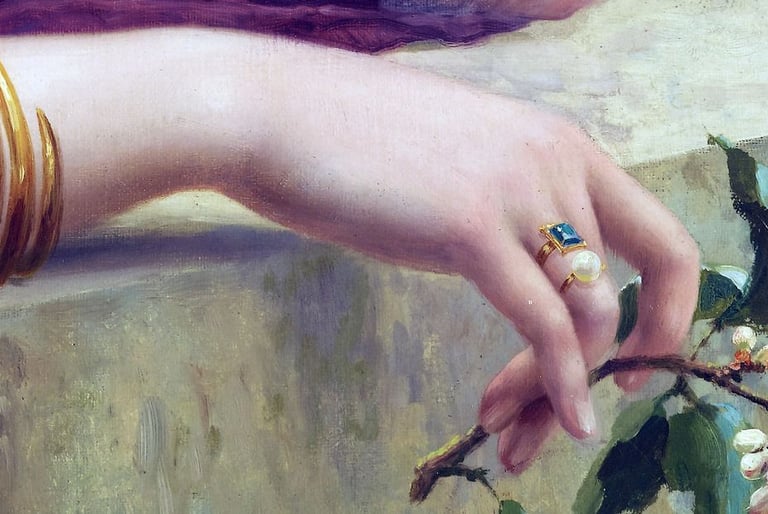
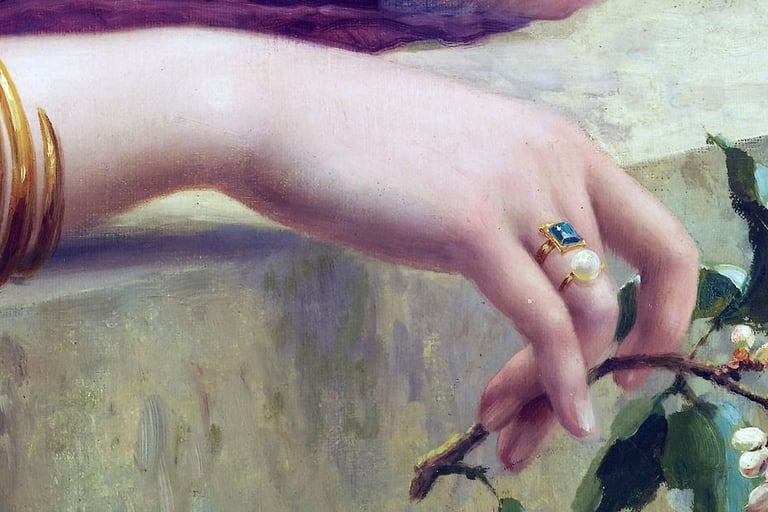
In Search of the Lost Ring
Any celebration in life is almost always filled with the anticipation of a miracle. Sometimes dreams come true as if in reality, and sometimes they are destined to remain mere dreams—and there is a certain charm in that too. Yet, from time to time, life presents us with less than pleasant surprises right in the midst of the most festive moments. Such instances make us reflect that there is always something beyond our control. It is a blessing if that something is trivial, the loss of which will not spoil our mood. But what if it is not?
On New Year's Eve, just such a story befell us. Had we not been masters of our craft, we would doubtless have spent the entire day searching for the lost item. Fortunately, we always have at hand our favourite predictive tool—a kind of wonder-machine capable of revealing answers to nearly any question that arises. After all, an astrologer must first and foremost be able to apply this knowledge in his own life. How else can one grasp not only the full complexity of the predictive art but also feel firsthand that behind every horary chart lies life itself, in one form or another? This is what makes astrology a living knowledge, reflecting life in all its diversity.
On the morning of 31 December, one of our family members discovered that the ring he had worn constantly for the past several years was missing. Naturally, the first thing we did was try to find it ourselves in the most likely places. We do not resort to astrology for every trifling matter and generally turn to it only when truly necessary. Of course, we had no wish to spoil our festive mood, and after an unsuccessful manual search, we turned to the predictive art—which, it seemed, had decided to prepare its own New Year's gift for us, in the form of a symbolic and precise answer.
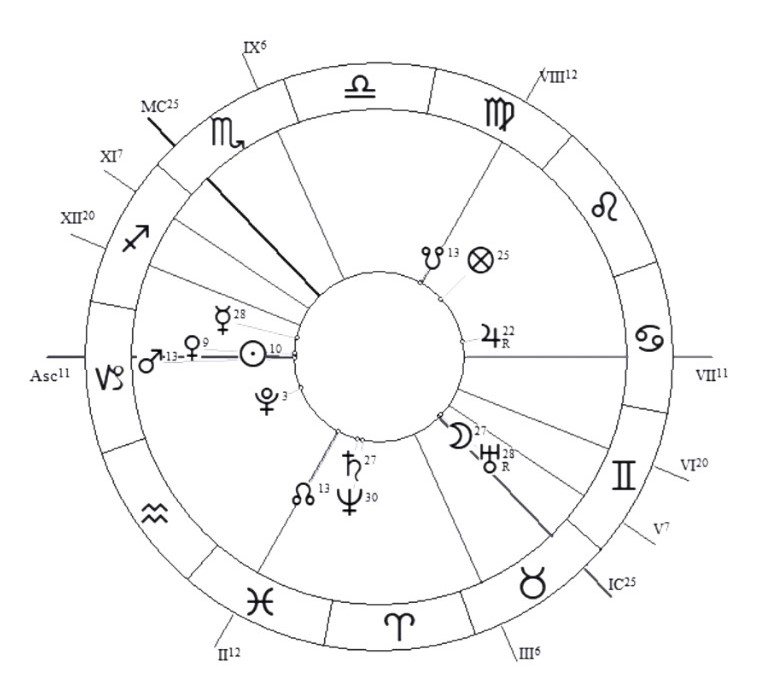
31.12.2025 09:14 (GMT +2). RIGA, LATVIA.
The question was asked by the person who lost the ring, which is important in the context of such enquiries. Had another person asked about a lost item belonging to a relative or friend, the delineation would have involved derived houses. Fortunately, we were spared such complications, as any family member can always approach us directly with a pressing and important question.
In questions about missing items, we very often turn either to the ruler of the second house or to the ruler of the fourth house—the house of movable possessions and our symbolic treasures. Indeed, for some, a cheap trinket can be a true treasure, valued not for its cost but for other reasons. Perhaps someone passes down from generation to generation something deeply meaningful to the family, like a brooch once worn by a great-grandmother, or some other object of non-material worth. It is perfectly clear that life contains things of symbolic significance that we would not sell for any price. It is precisely these that the fourth house often symbolises, governing both treasures buried in the earth and treasures in the metaphorical sense. Usually, we choose based on whichever better matches the description of the lost item—the ruler of the second or the fourth house? In this case, the second house is ruled by Jupiter, and the fourth by Venus. Venus, as adornment, would seem more suitable. Thus, our choice would normally fall on Venus—were it not for one crucial "but," whose name is context.
We did not introduce the comparison of the two houses by chance. These are all standard rules and techniques of horary astrology, which are extremely important and often indispensable in delineating various questions. But we must never forget that horary astrology is a living predictive art, in which charts merely reflect a given situation and its context. Had we overlooked the fact that the lost ring was not just any adornment but a golden one, we would have missed the essence. We might still have arrived at the same conclusions in the end, but by a roundabout path. Yet conclusions must always be reached by the correct route, as this minimises errors in judgement. Though astrologers sometimes answer correctly by sheer luck, it almost always leads to unfortunate consequences in subsequent questions.
We always tell our students that they must follow the chart of the question rather than the letter of books and textbooks. The latter are needed to understand the fundamentals, but they can never teach the delineation of charts if we try to confine them within the rigid framework of printed rules. Almost always, this leads to a great many errors in judgement. Literalism is pernicious. Skill, on the other hand, is beneficial. These are two diametrically opposed approaches in astrology. Very often, the bookish approach is called traditional, whereas it remains merely bookish. Tradition is not rules and techniques—these are only its outer form. We must always look into its soul—the essence of the predictive art. Only there lies the truth, which guides the astrologer along the thread of context. This is the very thread of Ariadne that leads out of the labyrinth of speculation, rules, possible interpretations, and the like.
But let us return to our delineation. Note the cusp of the first house. What immediately catches the eye? Of course, the Sun and Venus, as if pressing upon the querent's head—that which troubles his mind. The Sun is the natural ruler of gold and everything made from it, whether an adornment, an ingot, or something else. This is the lost ring itself. Venus also plays an important role here, but more on that shortly.
Natural significators play a major role in horary questions about lost items. We most often turn to them in cases involving gold, silver, or the loss of electronic devices signified by Mercury. This is especially true when the chart itself seems to point them out: "Hey, look—the Sun is right on the cusp!" If we considered only the rules, ignoring context and the chart itself, we would have erred. Why?
Imagine we had chosen Venus as the significator of the adornment. We would see Venus combust by the Sun, confirming that it is as if invisible, hidden in his rays. We would also note that Venus is in an earthy sign, suggesting the adornment is likely on the floor or low down. Venus's proximity to the Sun might indicate a location near something solar—something bright, golden in the interior, or a source of natural light, such as a window. All this on the assumption that the item was lost indoors, not outside—for in the latter case, we would first need to determine whether the item would be found at all; otherwise, describing its location would be meaningless. But we knew for certain the ring was lost at home, as it had still been on the querent's finger the previous evening.
Thus, choosing Venus would have led us partly in the right direction—but only partly. Whereas choosing the Sun as the significator of the lost item led us straight to its location.
The Sun is also in an earthy sign, meaning the ring is most likely on the floor. The Sun is in conjunction with the querent's house cusp, suggesting it is somewhere near him—either among his belongings or close to his usual place. And here Venus's proximity to the Sun provides the final and most crucial clue. Venus signifies all comfortable places, as well as places of rest and leisure. The querent has a favourite armchair where he likes to relax, read, watch television, and so on. It could also have been the bed where the querent sleeps. Or the querent's clothing, since Venus is the natural ruler of clothes—but then the earthy sign would have been superfluous.
And where was the lost ring? After nearly an hour of fruitless manual searching, and scarcely a minute after casting the horary chart, the ring was found exactly where the chart indicated—lying on the floor beside the querent's armchair. A wonderful New Year's gift from the predictive art. For what could be better for a horary astrologer than a chart whose answer is confirmed immediately? Only another horary question…


Subscribe to our blog
Astrological Centre Septener | Horary Astrology
"...In they Study, be Totus in Illis that thou maist be Singulus in Art; be not extravagant or desrious to learn every Science, be not Aliquid in Omnibus."
Copyright © SEPTENER, 2016-2026
ABOUT




William Lilly
Astrological Centre Septener was founded in 2016.
Our Centre applies the methods of Horary Astrology for accurate prediction and analysis of events.
Our mission is not only to provide consultations to other people, but also to revive interest in the Real Astrology.
IK SEPTENER
Latvia, Riga
+371 20136077
info@septener.com
Reg. No: 40002178384